PCS — Pistos Compliance Sentinel — turns the regulation into questions you can actually answer, keeps the supporting document behind every answer, and produces the compliance record on the day somebody asks to see it. Designed by former partners from Accenture, Deloitte, EY, and PwC who built compliance programs for Fortune 500 institutions across financial services, healthcare, and defense.
Pistos brings that institutional methodology to organizations under 500 employees, delivered through an AI platform that operates at a depth and scale no human team could sustain alone.
Pistos Compliance Sentinel V1 will be released on September 10!
From that day your compliance lives in one place instead of a folder of spreadsheets and a hope. See what it does.
One CISO enablement program. One platform. One outcome.
Regulations change. NY DFS amends. NIST publishes a new revision. OCR updates its audit protocol. Pistos monitors these changes continuously and updates your compliance posture automatically — so you are never caught off guard by a requirement that changed last quarter.
Most regulated organizations face three to five overlapping frameworks simultaneously. Pistos anchors every obligation to a single mapping — one implementation satisfies NY DFS, HIPAA, CMMC 2.0, NACHA, and every other framework that shares the underlying control. No duplication. No gaps.
Compliance is the floor, not the ceiling. Pistos reads what is actually configured in your environment — not what tools report about themselves. The result is a security program that genuinely reduces risk, not one that satisfies a checklist while leaving real exposures in place.
Generates and updates hardening scripts for Microsoft GPO, CrowdStrike, SonicWall, and the major security toolsets your environment runs — mapped to your applicable frameworks and updated as requirements change.
Configurations that reflect current requirements — always.Develops training modules specific to the threats targeting your industry, your toolset, and your regulatory obligations — updated continuously as the threat landscape shifts.
Training that reflects today's attacks, not last year's.Writes policies tied to your specific frameworks and the detailed procedures that tell your staff exactly how to implement them — not generic templates that require a consultant to interpret.
Documentation your examiners can rely on.Builds and maintains your disaster recovery and incident response plans — automated workflows, decision trees, and escalation paths designed to function under actual incident conditions.
Plans that work when you need them.Runs external vulnerability, web application, and internal network scans — and updates its own detection logic continuously. Reports are customized to your business context and regulatory obligations, not generic CVE lists.
Findings your team can act on immediately.Every part of PCS is one of these three steps, or feeds one of them. Nothing can be secured, or scored, until it is on a list — so the loop starts there.
Your equipment, your software, and your people.
Those are the three things that can be attacked, and the three that have to be secured. PCS keeps a live list of each: every machine and how it is protected, every application and whether you could survive losing it, every person and what they are allowed to reach.
Saying a control is in place is not the same as it being in place.
PCS scans your workstations, your applications, your Microsoft 365 or Google tenant, your line-of-business systems, and everything of yours facing the internet — then reports, control by control, what is switched on and what is not.
When somebody asks, you produce it.
Risk assessment and risk register, the scored results of every scan, who took which training and when, your disaster recovery and incident response plans, your asset inventories, and your security policies. Current, dated, and in one place.
Run them as separate projects and they drift: the inventory goes stale, the scans check last year's machines, and the evidence gets thrown together in the week before an examination. PCS runs them as one loop. Your inventory decides what gets scanned. Your scans become your evidence. Your evidence is ready before anyone asks.
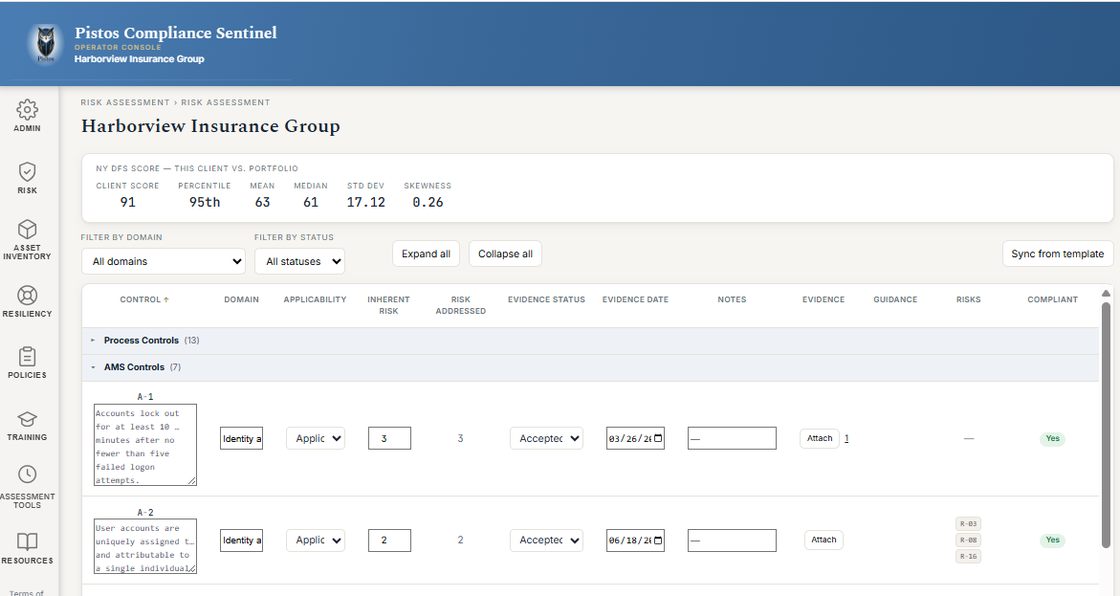
Other GRC platforms hand you a dashboard and expect you to figure out how to populate it. Pistos delivers eighty-five percent of your compliance program as finished work — automated where the technology allows, templated where the documentation requires it — and leaves only the small portion that genuinely belongs to your organization.
Every policy, every Skopein finding, and every evidence record in PCS is mapped against the eight authoritative sources that govern the industries we serve. One implementation. Many obligations satisfied simultaneously.
DFS placed strict due diligence obligations on insurance carriers, and carriers are passing them straight down to the agencies and aggregators selling their products. Pistos gives independent agencies and wholesalers the same quality of regulatory representation a regional broker's internal compliance department provides — including direct collection of SOC 2 reports from your AMS systems and carriers, so you stop chasing questionnaires that never come back.
For the insurance industry →Pistos prepares Tier 2 and Tier 3 defense subcontractors to pass CMMC 2.0 Level 2 assessment — with the leadership, evidence base, and technical controls a C3PAO will require. We are not a C3PAO, and by regulation no readiness firm can be. We are the partner who gets you ready and keeps you ready, at a fraction of what the established consultancies charge.
For defense subcontractors →Independent medical practices, billing companies, and healthcare technology vendors face HIPAA compliance under the Privacy, Security, and Breach Notification Rules — with the 2024 NPRM bringing substantially more prescriptive requirements. Pistos delivers the HIPAA program OCR expects to see — documented, current, and mapped to the audit protocol.
For healthcare →Regulated organizations in financial services, healthcare, and defense face the same four problems — and most address them with four separate, disconnected tools.
Technology stacks are complex. Vendor mappings go stale within months of a new release. No one has a current, unified view across the full environment.
Most regulated organizations face three to five overlapping frameworks. Treating each as a separate compliance program wastes resources and misses shared controls.
The gap is rarely the control — it is the document that proves the control was there. That is what fails an examination, and it is what carriers now ask for by name.
Regulations amend. Vendors release new versions. Threats evolve. No human team can monitor all three simultaneously without missing something consequential. AI can.
"Our carrier partners were pressing us on HIPAA compliance — we had no program, and they knew it. Our Aegis CISO took control and built it from the ground up: policies, procedures, and the security tool configurations to back them up. The partners have stopped asking."
Compliance Officer ◆ Healthcare Technology Firm
"We develop and host health insurance applications internally. We had no SDLC and no documented systems. Our Aegis CISO built the SDLC from scratch and put the processes in place to run and maintain our environment going forward. We went from no program to one that holds up under scrutiny."
CTO ◆ Health Insurance Software Developer
Founded by Pete Sfoglia, former partner at EY and Accenture, and mentor to CrowdStrike CEO George Kurtz. Pistos principals have published on cybersecurity compliance in National Defense Magazine, Insurance Journal, and Carrier Management. Read the published work.
Tell us about your regulatory obligations and we will explain how Pistos addresses them — without the sales process.
Request a briefing